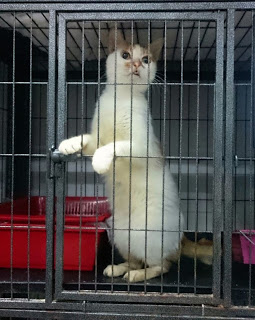
Meet Bo, one of our permanent residents at the cattery. Bo used to hang out at Botanic Gardens, and one day a regular LKP rescuer walking her dog noticed him looking very ill. She brought him to the vet where he was diagnosed as FIV positive with chronic renal failure.
The high life as a park-dwelling delinquent just isn't for everycat.
An early picture of Bo in his carrier
When Bo first came to us, he was so stressed out that he peed himself and needed a bath straight away. Thanks to a wide gamut of supplements and several tenacious volunteers, he is now in a much stabler condition than when he first arrived, and he slowly started eating more and gaining weight and strength.
Look ma, no paws!
Bo moping because he had to take the pill that makes him better.
Here
at the cattery, we manage his condition with Azodyl, a daily renal-specific
probiotic pill. While Bo loves getting head skritches and will purr contentedly
in a fluffy round cat-loaf when pet, he hates being handled, which makes baths
and regular clinical care challenging. Initially we tried administering
subcutaneous fluids, but Bo would have none of it and yowled, wriggled, bit,
and scratched even the most experienced volunteers. Since coming to stay
with us, Bo has also refined a staggering strategy to
resist his medication, using his core strength to stay at the furthest part of
his cat suite, and locking his jaw shut so we can't feed him the pill even with
the pill-popper and the strongest neck scruff. A single foster care volunteer
often has not enough hands to scruff Bo, pry open his mouth and put in the
pill, but still we manage to (almost every day... some days we concede and mix
it in with a bit of cat food). Luckily, Bo's kidney values improved on
just Azodyl and supplements (we give him vitamins B & C, colostrum, lysine,
aggression formula, echinacea, colloidal silver, astragalus, burdock,
dandelion, nettle, fish oil, and more general probiotics).
Recently Bo developed a skin issue, where he started to lose fur in patches on his face and neck, possibly due to an allergy to his favourite fishy foods.
Or is he just blushing??
Immunocompromised cats like Bo are prone to such issues, though, and we manage it with weekly medicated baths and daily topical medication. His skin has since improved a little, but for reasons unbeknownst to us humans, he seems extremely annoyed with his weekly spa experience.
Have you ever tried to keep an annoyed, soapy cat in the basin for ten minutes as his medicated shampoo does its thing, then rinsed him off and brought him to be towel and blow-dried? It's a party.
Notwithstanding all his recalcitrance and grumpiness, Bo has grown on us. He's scrupulous with his litterbox and fairly tolerant of other cats' shenanigans. We love his silly-looking, protruding, crooked tooth, and how he demands treats by sticking his paw out to prod at unsuspecting passersby or muss our hair when we're checking on Ah Niu in the suite below his). He is often seen tucking his paws under and sitting or sleeping in a round fluffy loaf of cat, and despite what he might tell you about his weekly spas, they help keep his fur lovely and soft.
Bo working it
Bo's funny tooth
Here's wishing Bo's coat of fur grows more evenly in 2016, and that he comes to terms with the benign daily necessities of medication so it's less of an ordeal on both sides. If you'd like to learn more about spotting symptoms of chronic renal failure, a common and manageable condition that affects ageing cats, sign up for our Cat Care talk with Dr. Dawn Chong on the 19th of December.
Donate to our cause by making a deposit to our Love Kuching Project DBS Current Account 027-905975-3 or viaCredit Card. Donate us food or litter at charity rates with free delivery via Pawfection
Elaine will be speaking on cat behavioural signs you should look out for to tell you that your cat needs to go the vet as it is unwell. Dr Dawn Chong will speak on one of the most common feline illnesses she sees in cats: chronic kidney failure. Diana and Rashid will lead a session on how to do subcutaneous injections on kidney failure cats. Elaine will also speak on holistic remedies for chronic kidney disease.
You will get a humble goody bag, barista made coffee and cookies together with the cats too, so it is a learning experience in a cat cafe setting.
How to sign up: It costs $20 per person for this event. Email to find out if slots are still available, if so, then transfer $20 to our DBS current account 027-905975-3 and then go to a Google form link that Elaine will send you. You can sign up as a pair/group.
See you on Saturday. It will be fun and meaningful.
Donate to our cause by making a deposit to our Love Kuching Project DBS Current Account 027-905975-3 or viaCredit Card. Donate us food or litter at charity rates with free delivery via Pawfection
We might have -finally- found a grooming powder suitable for use on the shelter cats, and is easy to procure: this product is from iHerb. Actually meant for babies, but ingredients are safe and even include extracts like echinacea and goldenseal. There are no artificial ingredients at all. Very hypoallergenic.
Costs S$9.27 before discounts and delivery charge.
Grooming powder is not only useful for combing out matts for a longhaired cat. After we bathe cats, some are not able to stay still to the end of the blowdrying session. Other wouldn't even let the hairdryer near them. For kittens we wet wipe daily because they are dirtier, powdering them after makes them stay dry.
[It is also a protip to powder white paws and other areas before a photoshoot.]
Buy the powder fr om iherb.com, and if you are a first time iherb customer, use our code AVA985 to get US$5-10 off your first purchase. This also gives us credits we can use to offset the supplements we buy from iherb for the sick cats.
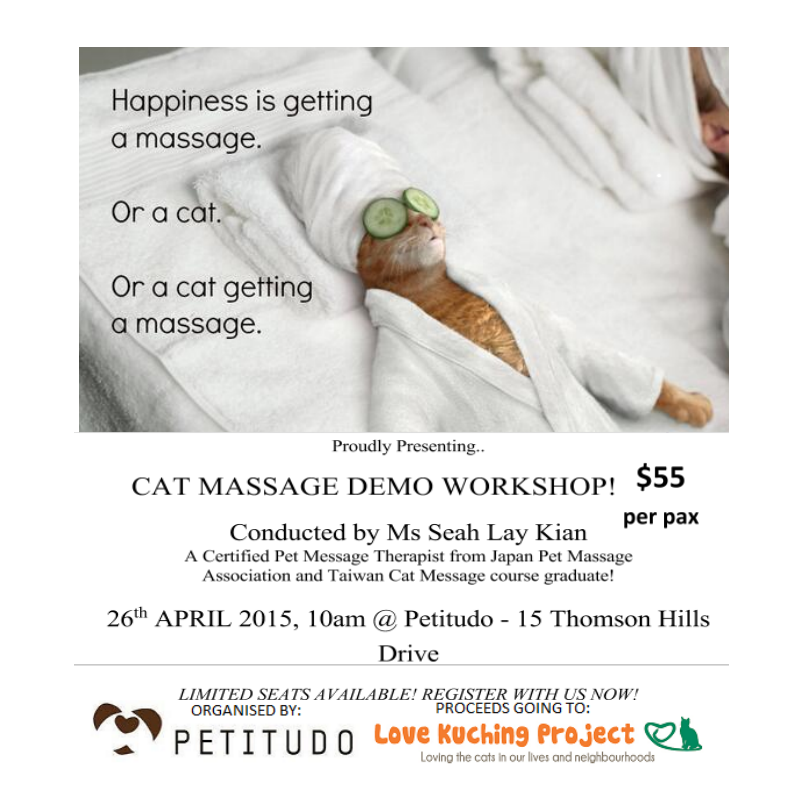
Pet services boutique, Petitudo, is organising a cat massage workshop that raises money for us!
To sign up, contact Petitudo at 98476050 or email to hello@petitudo.com
Donate to our cause by making a deposit to our Love Kuching Project DBS Current Account 027-905975-3 or viaCredit Card. Donate us food or litter at charity rates with free delivery via Pawfection
Love Kuching Project gave a talk for volunteers of NTU Cat Management Network on Saturday on signs of sickness in cats.
Many cat rescuers would seek their gut instinct to determine if there’s something wrong with our community cats. But on occasion, gut instinct might not be enough; no matter how well we speak Cat, they can’t tell us directly when they feel sick.
So, here’s some of the signs we covered (and some other tips we gave):
1) Behavioural changes
Cats are not creatures of habit, but you can trust your community cat to be consistent; they will behave in a set manner.
Thus, behavioural changes can be easily detected in a cat, provided if you know the cat well. If your community cat is sleeping most of the time and you chance upon it sleeping - that would be normal behaviour; but if the cat is usually active and you find it lethargic, there might be a problem.
Aggression may also be a sign. Sickness is weakness - and cats in nature will tend to hide such weaknesses by protecting itself against enemies and predators. A sick cat may hence be more aggressive. If, for example, the cat is usually very shy or feral, then aggression may be a usual occurrence.
The same applies for shy cats - if a cat is usually shy, hiding would be part of its usual behaviour. There may be something wrong if a cat that is usually friendly becomes shy.
2) Visible third eyelid
Scooter, one of Love Kuching Project’s resident cats, in 2010. The white part is a visible third eyelid.
The third eyelid is present in cats - but it is usually hidden and invisible. When the third eyelid is visible on the inside corner of the eye, it is protruding, and a sign of sickness. The membrane may also be visible when a cat is resting or has just woke up from anaesthesia. In these cases, the eyelid will usually retract when they are alert or startled.
3) Dehydrated
Dehydration often occurs when a cat is unable to eat or drink due to pain in the mouth. It may also be because of more serious illnesses, such as kidney failure.
The pinch test is used to determine if a cat is dehydrated. A healthy cat’s skin will go back to normal when the skin is pinched and released; but a dehydrated cat’s skin will remain ‘tented’:
4) Conjunctivitis
Teo Heng, a former Love Kuching cat. Teo Heng suffered from flu, which caused severe conjunctivitis.
Conjunctivitis is when the eye is inflamed and produces discharge. The discharge may be clear, or pus-life. It usually indicates cat flu, which can be dangerous for young kittens and senior cats - as well as those who are immunocompromised (like cats with FIV).
Cats with cat flu will also sneeze and be feverish.
5) Fur loss and scratching
Fur loss, presenting itself as bald patches of fur - coupled with scratches on those bald patches - may indicate a skin condition. Most common skin conditions include allergic flea dermatitis and mites; which can be cleared by Revolution - medication that destroys fleas and ear mites.
Limping indicates injury - and cats who limp may have had a bad fall, or it may have had some sort of accident or trauma. The cat may also be unable to move one or both of its hind legs - this might be caused by slight paralysis from a spinal injury.
7) Drooling
Drooling is almost always a sign of gum disease. Like humans, cats with bad teeth and gums will also have bad breath. Gum disease can be treated either with medication or surgery - but if the cat is immunocompromised, gum disease will be chronic and require long term medication.
8) Flesh wounds
Flesh wounds can look like open wounds or bleeding puncture wounds, swollen abscesses (filled with pus) or large torn skin ‘holes’ in the cat skin, exposing flesh underneath. A wound that is not tended to can turn into an abscess - and if the abscess bursts, the cat’s skin will tear, requiring surgery to stitch it back together. As such, it is important that a cat with an open wound be treated for its wound as soon as possible, to prevent the wound from getting infected and turning into a abscess.
Swollen lumps can indicate other illnesses as well, such as tumours and hernias.
9) Colour of gums
If a cat is close enough to you and allows you to touch its mouth, checking the colour of the gums may also provide a good indicator of disease.
Here’s how you check a cat’s gums:
Take note when handling the cat around the mouth, however - if the cat has gum disease, it might feel pain and retaliate.
Here’s what you can do if you find a sick or injured community cat:
Find out if the cat has a caregiver. If you find the caregiver, inform them that the cat is sick, and ask for more information regarding its behaviour.
If you have a fosterer for the cat, or if you can foster the cat, you can ask for our assistance via the Emergency Rescue Fund. If not, Love Kuching can only take the cat in if our cattery has the space.
You can then trap the cat and bring it to the vet (ER Fund consultations are to be made at the Animal Clinic only)
Donate to our cause by making a deposit to our Love Kuching Project DBS Current Account 027-905975-3 or viaCredit Card. Donate us food or litter at charity rates with free delivery via Pawfection Follow us on Facebook, Twitter and Instagram
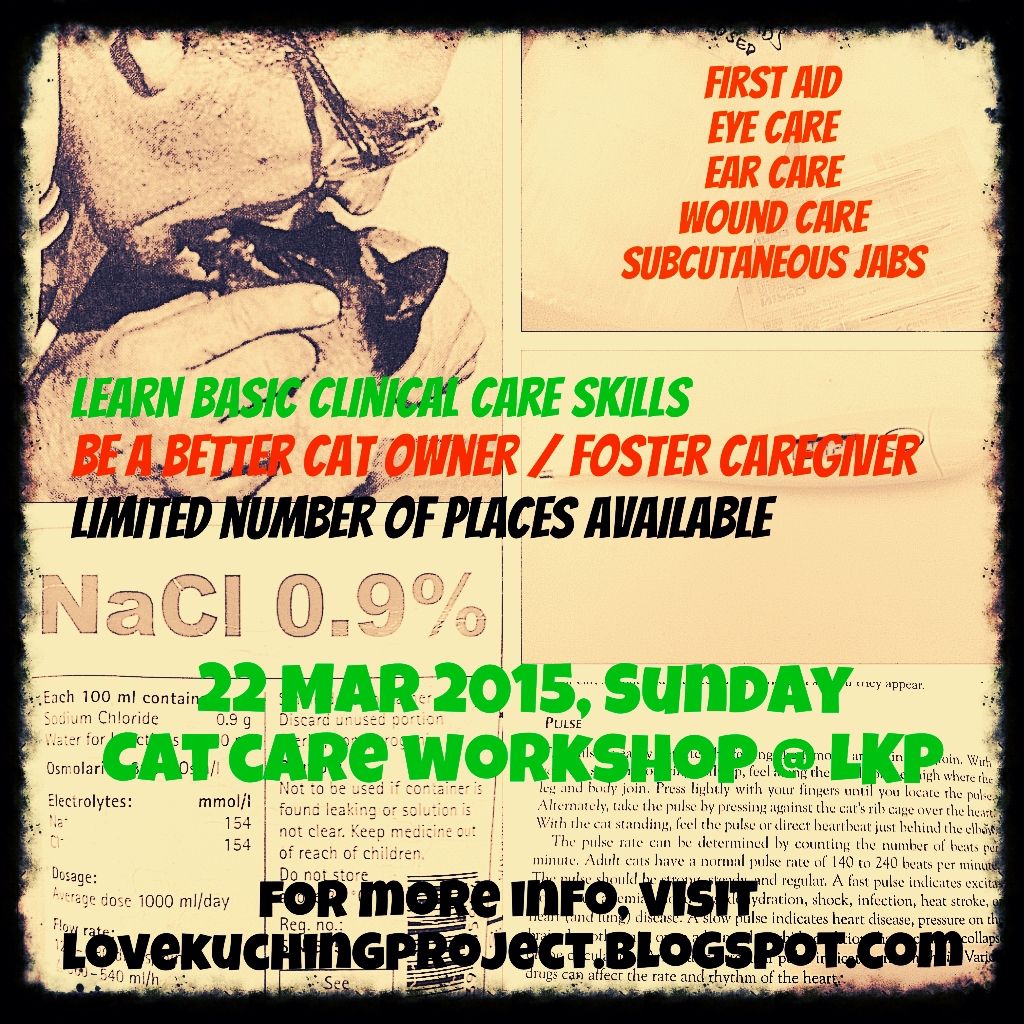
It is time for our first cat care talk of 2015! Proudly brought to you by our Cat Care Outreach and Foster Network teams. This event will be a hands-on workshop limited up to 10 participants only, so if you want to join in, sign up fast!
It is easy to care for a healthy kitten or cat, one that has clear eyes, clean ears, no injuries or sicknesses of any kind. But what if you had to suddenly learn to care for a sick kitty?
This workshop is here to teach you the basics of clinical care for cats that you could benefit from as a cat owner or as a foster caregiver for sick and injured stray cats. It will be a workshop based event that is participant led, so you can feel free to ask any questions pertaining to the the topics that will be covered.
Each participant will receive a door gift - a travel-sized first aid kit.
Details of the event:
Venue: LKP at Ubi Ave 1
Date: 22 March 2015, Sunday
Time: 3-5pm
Cost: $10
How to sign up:
Transfer the $10 cost per person to our DBS current account 027-905975-3, retain the transaction details, and go to this link to key in your information. If you are registering for more than one person, transfer the tallied amount and use the form to sign up as a pair/group.
Donate to our cause by making a deposit to our Love Kuching Project DBS Current Account 027-905975-3 or via Credit Card Donate us food or litter at charity rates with free delivery via Pawfection
What do Neko no Niwa and Love Kuching Project have in common? We believe that rescued cats can be beautiful and affectionate companions too, if only they get a chance. We also believe in giving our cats the best care we can afford with the best knowledge we have. This workshop will be presented by Elaine Chiam, President of Love Kuching Project and Samuel Chua, co-owner of Neko no Niwa - they both have great passion and extensive knowledge in their respective areas. The aim of our cat care workshop is to make the cat-parent journey an easier and happier one! How to be a better cat parent Suitable for current cat owners
- Nutrition & Hydration
- Supplements
- Grooming
- Medical causes of behavioural problems
- How to manage cats who are fearful and aggressive
- Alternative therapies for behavioural problems
Fees for this 2-hour workshop, conducted amongst 13 adorable rescued
cats, is at $24/pax with a free drink. You will each receive a goody bag of supplement and essential oil samples, cat food, treats, cat-themed art, jewellery and stationery as well as discount vouchers worth more than $77, and a booklet for free cat themed art workshops with Art Social Haus! Capacity is limited so please
register and make payment online to secure your seats early. To register, click here.
Neko no Niwa is located at 54 Boat Quay, Singapore 049843.
Thank you Neko no Niwa and our sponsors for making this possible!
Donate to our cause by making a deposit to our Love Kuching Project DBS Current Account 027-905975-3 or via Credit Card Donate us food or litter at charity rates with free delivery via Pawfection Follow us on Facebook, Twitter and Instagram
DBS Current Account 027-907655-0 Email fundraising@lovekuchingproject.org after you give so that we can verify receipt and send you a receipt if you need one (not tax-deductible alas, as we are not a IPC).
How to adopt
Visit lovekuchingproject.org/adopt/ to find out more about the cats and kittens that are currently up for adoption, and how you can bring them home!
Adopting from Love Kuching Project will require an Adoption Fee from the adopters. This is to: 1) Prevent the pet from being abandoned again 2) Prevent the pet from being re-sold at a profit 3) Cover part of the animal's boarding expenses 4) Help us further our work in rescuing and re-homing animals-at-risk and unwanted pets 5) Cover potential veterinary costs of rescued and stray animals in our custody 6) Cover vaccination costs


 Donate to our cause by making a deposit to our Love Kuching Project DBS Current Account 027-905975-3 or via Credit Card.